【Patent】Strategic Subtraction in Patent Drafting Lessons from the “Fortune Cookie” Design Patent Litigation

When applying for a design patent, applicants often attempt to emphasize uniqueness by adding descriptive statements to the specification. However, a recent judgment[1] from the Taiwan Intellectual Property and Commercial Court (IPCC) serves as a vital reminder: unnecessary or improper descriptions can backfire, providing a basis for the court to classify key features as “prior art” and significantly weakening the patent’s strength.
I. Introduction and Case Background
The defendant (patentee) held a design patent for a “pendant” (No. D221821) resembling a fortune cookie. When the plaintiff released a “fortune cookie birthstone necklace,” the defendant sent a warning letter alleging infringement of the patent at issue. In response, the plaintiff filed a civil action with the IPCC seeking a declaratory judgment as to whether the defendant, based on that design patent, had the right to demand cessation and removal of infringement, as well as damages, against the plaintiff’s “fortune cookie birthstone necklace.”
Comparisons between the patent at issue and the allegedly infringing product are provided below[2]:
| The patent at issue | The allegedly infringing product |
.jpg) .jpg) |
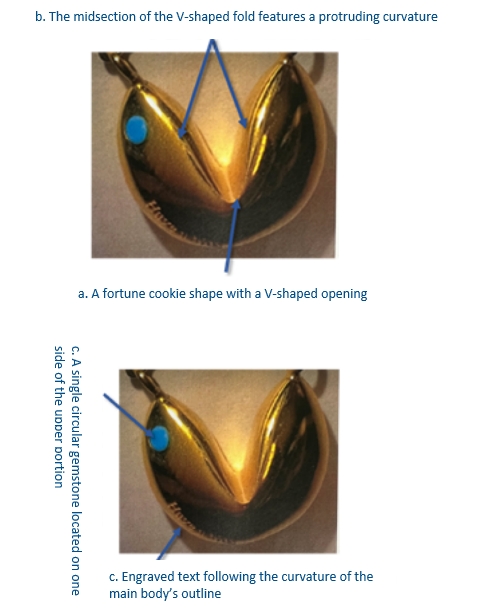 .jpg) |
The IPCC ultimately ruled in favor of the plaintiff, finding no infringement. A core factor was the patentee’s own admissions in the patent specification regarding the nature of the design.
II. The Cost of Over-Description: Admitting Prior Art
The “Description of Design” section of the specification includes the following statement: “The appearance of this design is like a fortune cookie; the body is designed with a V-shape on the front and a V-shaped opening at the top.” While this vividly described the product, it had unintended legal consequences:
1. Limiting Weight Distribution: The IPCC held that because the patentee admitted the design was “like a fortune cookie,” which is a shape well-known to the public, the core features (V-shape and curvature) were effectively identified by the patentee as common prior art.
2. Non-Monopolization of Known Forms: The IPCC explicitly noted that while variations of fortune cookies exist, the fundamental aesthetic belongs to the public domain and cannot be monopolized by the patentee through this specific claim.
III. Infringement Comparison: Focusing on the Nuances
Once the “Fortune Cookie” shape was regarded as common prior art, the comparison focused on specific ornamental differences:
- The patent at issue: Featured a ring of inlaid diamonds along the lower edge.
- The allegedly infringing product: Featured a single circular birthstone on one side and engraved text.
The IPCC concluded that because the core shape was already known, an ordinary consumer would focus on these distinct decorative elements. Given the clear differences in diamond placement and engraving, the two products created different visual impressions, resulting in a verdict of non-infringement.
IV. Implications for Patent Prosecution and Litigation
This judgment highlights several critical strategies for drafting design patent specifications:
1. Avoid “Natural Object” Analogies
Describing a design as “like a fortune cookie” or “like a leaf” may inadvertently limit the scope of protection by unintentionally conceding that the design elements are part of the prior art.
2. Precision over Promotion
The specification is a legal boundary, not a marketing brochure. Every sentence should be scrutinized for how it might later be used by a competitor to narrow the patent’s scope.
3. The “Subtraction” Principle
Rule 50 of the Enforcement Rules of the Patent Act prescribes that the specification of a design patent application should include the following items: title of design, purpose of article and description of design. The purpose of article and description of design may be omitted if these items are clearly reflected in the title of design or the drawings. Therefore, if a description does not help define a novel and creative feature, it should likely be removed. Excessive detail regarding standard features often creates vulnerabilities during litigation.
V. Conclusion
A successful patent specification should function like a precise instrument. As this case demonstrates, unnecessary self-definition can anchor a design to prior art, making it easier for competitors to design around the more difficult for the patentee to enforce its rights.